- The Resilience Brief
- Posts
- Dual thinking
Dual thinking
We can be afraid AND confident at the same time

Carre Le Page
February 04, 2026
Last week, professional climber Alex Honnold did something that had the world watching. He climbed Taipei 101, one of the world’s tallest buildings, and he did it without any ropes or safety gear. He made it, taking a selfie at 1,667 feet, live on Netflix.
Most of us can’t even comprehend a challenge like that. I can imagine the nerves at the base, looking up at that wall of glass and steel. But after the first five metres, I’d be done. Panic would take over.
And yet, Honnold climbed it. Personally, I think it’s a great example of resilience, and his ability to hold onto a powerful idea that we can hold two truths at once.
He felt the risk and he moved forward anyway. That distinction matters, because it proves we don’t live in a binary world.
In interviews before the climb, Honnold talked about managing fear rather than eliminating it. He described fear as something very real in the body. He knew it was always there, ever-present and noticeable, but it was not something he allowed to dominate his decisions. Years of preparation and mental rehearsal meant fear became something he could observe and regulate, rather than fight or dramatize.
This is the critical piece: fear was still present, but he simply treated it as information, not a threat. Much like acknowledging our own nerves before a big presentation… and still stepping up to speak.
In a society desperate to reduce life to black or white soundbites (we’re either “fearless” or “terrified”), Honnold’s climb is a visceral reminder that real life happens in between.
We can be afraid and confident. Nervous and capable. Aware of the risk and willing to engage.
In fact, it’s the best way forward.
That one tiny word
We live in a world that supports zero-sum thinking: if I win, you lose.
Which is why language matters more than we realize. Any writer will tell us that the way we phrase things does more than describe reality, but actually shapes it. That’s both fragile and powerful. A single word can collapse a story… or open it up.
I’ve written about this before, and this time, I’m obsessed with a very simple word that can reframe this zero-sum thinking:
And.
“And” refuses the false choice. It breaks the trap of either/or and makes room for multiple truths to exist at the same time.
He’s difficult and kind. She’s chaotic and brilliant.
That’s dual thinking. It’s holding two truths at once.
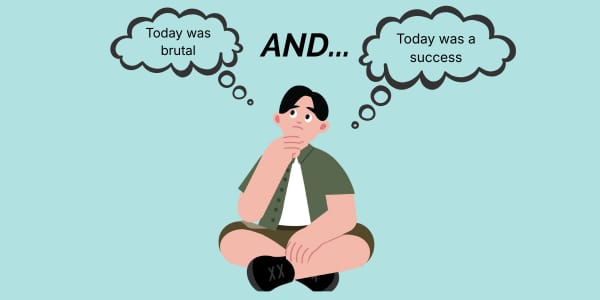
We’ve probably felt this recently: “Today was brutal.” or “Today was a success.”
Both can be true, but our brains want the simpler version. We cling to one sentence with a clean verdict. It costs less energy and gives us the comfort of certainty and control.
But that’s not real life.
The cleaner, truer version sounds like this: Yes, it was a tough day and I delivered.
Yes, 2026 is already challenging and I have what it takes to move forward.
Dual thinking is our ability to stay grounded without denial. To hold complexity without spiraling.
It’s the same pattern Alex Honnold used on that wall by seeing the risk and trusting his preparation. And that’s real strength under pressure.
Practicing dual thinking.
Expect complexity. Life almost never fits into one easy box. It’s a mess that we work out as we go. In fact, it’s in this chaos that we need to practice this dual thinking. When we’re frustrated by how slow progress is, it’s a moment to practice gratitude. Because it is possible to be frustrated with work and be grateful for the income at the same time. Just like we’re proud of our wins and hungry for more. Resilient people aren’t confused by this. We expect complexity. As soon as we learn to hold two truths at once, we stop arguing with this complex reality and look for a way forward.
Kill that emotional whiplash. Single-truth thinking makes our emotions swing back and forth. If we have a bad day, the first reaction is that “everything is terrible.” But if we get a big win, then “everything is amazing!” It’s a boom/bust world and, if we can tap into the idea of dual truths, we end up giving our nervous system some steadiness. Yes, we might be disappointed and we know this feeling will pass. Yes it’s hard and we’ve handled this sh!t before. We need to look for the “and” in every scenario.
Avoid catastrophizing. Our human brains love drama. That’s how the social media giants have hacked our attention with rage bait. Sadly, the feeling that follows is that we tend to associate a common theme with the content we consume. In other words, “if this is bad, everything is bad.” It’s particularly debilitating when we face a real struggle. Our first reaction is to think we’re falling apart, but dual truths interrupt the pattern with grounded reality. This is hard… and we can stay steady inside it. When we widen the frame we calm the chaos.
Build self-trust. Every time we let ourself hold both the hard truths and the steady ones, we send a clear message to the brain that we can handle it. This isn’t toxic positivity or fake bravado either. I certainly don’t think we’re pretending everything is fine. Instead, it’s the confidence to know that whatever rises, we can meet it without collapsing.
All of this comes back to one small, defiant move: choosing “AND” instead of trapping ourself in a corner. Because when we stop forcing life into either/or, new options appear. It happens in ordinary moments and also under real pressure.
Every time we practice this, we widen our perspective, loosen our grip, and calm our system. That’s what makes us harder to knock over and also also why dual thinking is the backbone of durable resilience.
Until next time friends,
Carré at Resilient Minds
PS - if this resonates, please forward along to a friend who might benefit.
What did you think of today's newsletter? |
Reply