- The Resilience Brief
- Posts
- There's no manual for modern work
There's no manual for modern work
Navigating the complexity of life in 2026

Carre Le Page
March 04, 2026
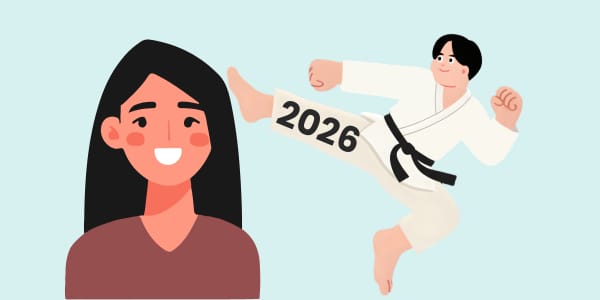
Emails and roundhouse kicks.
Last month I had a moment at my 5-year-old son’s Taekwondo class. It was a Friday afternoon and his class (catering to the schedules of modern parents) conveniently started at 330pm. ;-) That particular day I noticed four dads in the audience who’d brought their laptops in the hope of tying up work before the weekend. I was one of them.
It struck me as sad and desperate at the same time. Here we were, trying to be present for our kids, but failing miserably. We missed all the kicks and punches to focus instead on Slack notifications and last-min emails coming in before the weekend hit.
Yes it felt sad, and rushed, and annoying…. but it didn’t feel guilty. And the reason for that is that it was 330pm and I still had work to do. This is just the world we operate in now: the lines of work and life are so blurred that we can attempt to review a contract and watch a roundhouse kick in the same 15-second span of time. I just wonder if we do either of them well.
Such is the modern world we are in. And really, that balance of martial arts and Outlook management is just scratching the surface.
Add to this great juggling act all of the other chaos and confusion that abounds in 2026. Inflation, legitimate job security worries, new technologies, war, a burnout bonanza, significant loss of trust in global leadership, rage bait, the list goes on and on. Meanwhile, the work is accelerating with expectations to “learn AI” while also doing all the work that AI is supposed to remove any day now. We're asked to show up, perform, adapt, grow, be resilient, take care of our mental health, attend the team social, reply promptly, and be present.
It’s a lot to navigate, and there’s no manual for how to operate in 2026.
Has it been this way for a while?
I remember another moment from a few years back, during the early fog of COVID. I was on a Teams call and an email came in about a different project underway, then I got pinged on a separate Teams chat while my phone buzzed with a personal notification. 4 different worlds collided in the space of 15 seconds, so much so that barely any of it was registering. I remember thinking that the flipping and flopping of tasks and projects in my mind couldn’t be good for my brain, nor would it make me very good at my actual work. Again, no one seems to have been trained for this. We’re just finding our way through it all. The question is whether it’s working.
I’m not sure it is.
Because underneath all of it, we're running 2026 demands on an ancient operating system. And (when we look at the numbers) the crash is already happening in the form of anxiety, stress, and burnout. We need an update, without the spinning wheel of death.
So what does a resilient operating system actually look like? Here are a few tools to consider as a start.
Stop managing time. Start managing energy. I’m a huge believer in energy. We have the same 24 hours as everyone else, but the problem isn't necessarily our schedule, it’s how we allocate our energy. The fact is that a lot of us are depleted. Depleted from the non-stop pace of life, the constant notifications, the always-on nature of it all. A better approach could be to ask what state we need to be in to be our best. Some of my worst decisions were made in the last hour of a long day. Some of my best thinking happens on a Sunday morning after I've actually slept. The task is the same. The person doing it is different. Adjust for energy.
What actually matters. There’s freedom in the ruthlessness of determining what the priority is. Note the singularity there… the word “priorities” didn’t actually exist until recently because “priority” only ever refers to just “one thing”. But the modern world won’t stand for us being single-mindedly focused on a task. Here’s the truth bomb our bosses will never tell us: when everything is urgent, nothing is. Most of us spend our days reacting to messages, requests, other people's needs, and then we arrive at 6pm genuinely unsure what we moved forward. In a world where leadership is stretched thin and strategy changes mid-month, we have to develop our own internal compass. What are we actually trying to do? What are we not willing to sacrifice to get there? Because if we don't answer those questions, the inbox will answer them for us.
Default to subtraction. Many people seem addicted to adding more stuff into our lives. More activities, more information, more ‘Instagram moments’. Even travel plans cause us stress because we jam so much into the minimal time we have on break. But let’s consider what could be removed instead of added. The instinct in chaos is to do more. The smarter move is almost always to do less, but better. Let’s start small by killing one meeting or doom-scrolling session this week.
Recovery as a skill. This one never gets old, and I wrote about it in detail last week.
All of this takes time. Building new ways forward is often a slow, messy process of noticing what's not working, questioning assumptions, and gradually (imperfectly!) finding a way of showing up that fits the world as it actually is.
That's what resilience means to me. It’s an ongoing process of iteration and improvement by asking what needs to change and seeing what we’re willing to do about it. It all comes down to choice.
It’s hard out there folks, but we’re doing a great job of finding our way through. Keep going.
Carré at Resilient Minds
PS - I love writing about this, but getting in front of people is even more powerful. I offer lunch and learns, workshops, keynotes and webinars to help teams and organizations find a way through all of this. Hit reply and let’s chat!
What did you think of today's newsletter? |
Reply